
With its centuries old history, Istanbul hosts many historical buildings. Despite this fact, a significant amount of beautiful buildings were lost in time. The Sultaniye Pavilion is one of them.
Called as “Sultaniye Köşkü” in Turkish, we have very little information about this quite interesting and actually unique pavilion. It is considered as the only palace building in Ottoman architecture constructed on water.

Sultan Beyazid 2nd, who reigned between 1481 and 1512, was the patron of this innovative building. Located in the Paşabahçe Cove, this small pavilion was decorated with tiles as it was a usual practice for palatial buildings. Experts believe that those tiles and kalemişi (penworks) may have a Central Asian and Akkoyunlu (Aq Qoyunlu) influences on them, showing the cultural interactions between different Turkish dynasties.
The most realistic depictions of the Sultaniye Palivion was the drawings made by Swedish officer Cornelius Loos who visited the city in 1710. Cornelius Loos was one of the three Swedish officers who were assigned by Swedish King Charles 12th. After his defeat against Russians, Swedish King Charles 12th took refuge in the Ottoman lands. He wanted to get a better understanding of his new hosts, therefore three Swedish officers started to explore the Ottoman lands with a mission “to view existing rarities and monuments and to draw them”. Cornelius Loos provided over 250 drawings in 1711. Unfortunately only 49 of them survived. His drawings are now in the National Museum in Stockholm, Sweden.
Loos’s drawings provided two different perspectives to the lost building. The first one was drawn as if there were drones on those years. It is a bird’s eye view with a side perspective. The pavilion building seems to remain over the water thanks to what appears like piled up stones and tree logs. The pavilion has a closed section covered with a dome, which was crowned with an “alem” (finial) on its top. The pavilion’s other section was a colonnaded balcony, surrounded with a marble railing. The slim, long and pen-like chimney seems to possess a balancing role within the overall design.
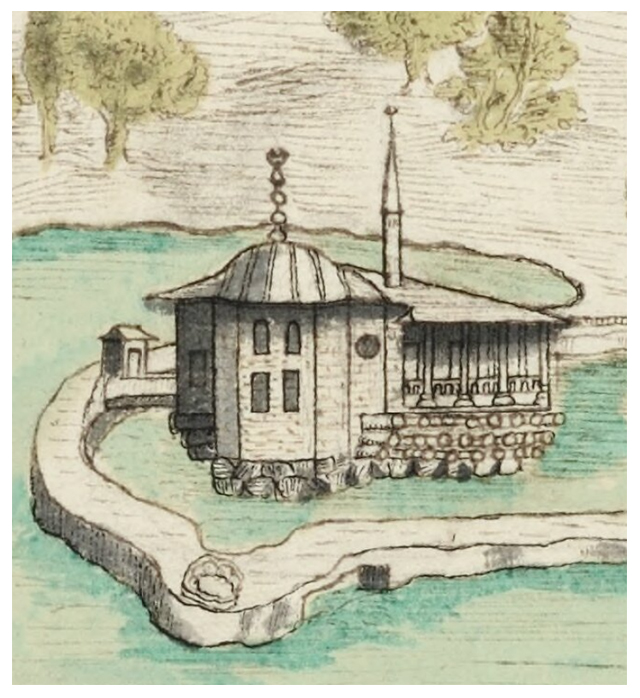
In addition to the pavilion, a fountain, a smaller building (probably used by sultan’s entourage) and two dalyans (wooden fishing platforms) are visible in Loos’s drawings. Most probably, all these buildings should be considered as a külliye (a compound).

Loos’s second perspective is even more exciting. His frontal drawing transcends balcony’s columns and provided us a clear view of how the pavilion’s exterior was decorated. In the middle, we can see the main entrance gate, most probably made of marble and decorated with a kitabe (building inscription). The gate and side windows were completely surrounded with tiles. Earlier, I mentioned that the pavilion is thought to have tiles and penworks with Central Asian and Akkoyunlu influences. By looking at Loos’s drawings, it is not possible to tell whether these are original tiles from Beyazid’s era or tiles from a later renovation. From a closer look, tiles appear to be hexagonal in shape, probably adorned with stylized flowers.

What is obvious is that with the disappearance of this building, Istanbul lost a very interesting and valuable heritage. The pavilion was probably damaged and disappeared as a result of strong earthquakes that affected the city during the 18th Century.
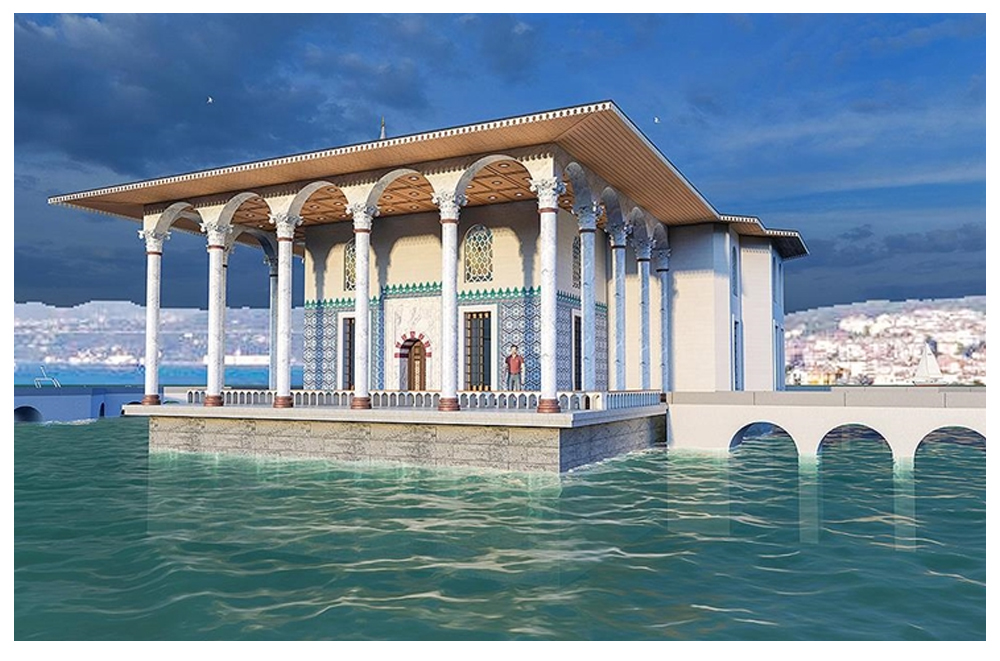
Recently, architect Bayram Çevik created a 3D model of Sultaniye Pavilion by referring to historical texts and drawings. Now these scientific and architectural efforts are in progress, maybe someday in 21st Century, this 15th Century pavilion will reappear in Paşabahçe with a new function and become a sight for citizens as well as for tourists.
Source: Anadolu Agency, National Museum in Stockholm.
 Not To Miss Moments
Leave a comment